

31 July 2026
Welcome to the Twentieth Edition of The Inside Track.
Here we are already at the end of July. With the school holidays behind us, Cape Town’s winter has felt sunnier than usual, with fewer of the long, wet stretches we normally associate with this time of year.
El Niño may yet bring less predictable rainfall and an unusually hot summer. Fortunately, May’s heavy rains left Cape Town’s dams in a stronger position.
The Springboks and Team South Africa have also given us something to enjoy, with Chad le Clos becoming the most decorated athlete in Commonwealth Games history after winning his 21st medal.
Weather and markets have one thing in common. Neither feels obliged to follow the forecast.
Globally, July kept investors focused on artificial intelligence, inflation, energy prices and geopolitics.
Closer to home, the South African Reserve Bank left rates unchanged at 7%. The US Federal Reserve did the same, despite persistent inflation and a divided vote, unsettling bond markets and pushing long-term borrowing costs higher.
Uncertainty has a way of showing which decisions matter, which can wait, and where a little margin for error may prove useful.
So, with that in mind, let’s get into this month’s Inside Track.
Market Indicators
Returns % (to 24 July 2026)
| 1 Month | YTD | 1 Year | |
|---|---|---|---|
| SA Equity (ALSI) | -0.3 | -3.7 | 13.3 |
| SA Bonds (ALBI) | -2.2 | 1.8 | 17.3 |
| SA Property (ALPI) | -1.4 | 3.2 | 23 |
| SA Cash (Avg. SA Money Market Fund) | 0.6 | 3.8 | 7 |
| Global Markets (MSCI ACWI in ZAR) | 1.3 | 11.4 | 13.7 |
| Global Markets (MSCI ACWI in USD) | 0.2 | 9.8 | 19.0 |
| USD/ZAR - R16.65/USD at 27 July 2026, negative number indicates appreciation of the rand | -0.22 | -0.4 | -7.7 |
Market Pulse: Market Moves and Your Portfolio
Since the conflict with Iran began at the end of February, markets have struggled to build sustainable momentum.
South African equities are down 3.7% for the year, while bonds and property have delivered only modest returns. Global markets remain positive, but growth has also been fairly inconsistent, with the MSCI All Country World Index, comprising approximately 2,500 companies across developed and emerging markets, gaining just 0.2% in US dollars over the past month.
The problem is not simply bad news, but the constant back and forth. Share prices reflect expectations about future earnings, interest rates and risk. When those expectations keep changing, so does the price investors are willing to pay.
Each new development shifts the outlook for energy prices, inflation and interest rates. The result has been plenty of movement, but very little progress.
With the US midterm elections approaching, domestic economic pressure may increasingly influence the administration’s approach to the conflict. Whether this leads to renewed negotiations remains uncertain.
Trying to time the next move is rarely realistic. The more sensible course is to remain patient and continue investing consistently. Weaker prices can create opportunities, and rand-cost averaging, investing a fixed amount each month, allows investors to buy more when prices are lower. Over time, this can work in their favour, provided decisions remain anchored to the objectives the portfolio was built to achieve.
Key Global Market Insights
-
US tariffs widened again. New duties of 10% to 12.5% were imposed on imports from 60 trading partners
-
Oil moved above $100 a barrel. The rise revived inflation concerns and increased the possibility that interest rates may remain higher for longer
-
The Fed, ECB and Bank of England all held interest rates steady. The Fed remained at 3.50% to 3.75%, the ECB’s deposit rate stayed at 2.25%, and the Bank of England held at 3.75%, although three members voted for an increase
-
Chip shares entered a bear market. The main US semiconductor index fell more than 20% from its June high as investors questioned the returns from record AI spending
-
Microsoft added nearly $450 billion in value in one day. Its shares rose more than 15% after strong results, the largest single-day increase in market value recorded by any company
-
The US economy grew by 1.5%. The headline disappointed, but consumer spending rose 3.2% and business investment remained firm
Key South African Financial Insights
-
The Reserve Bank held the repo rate at 7%. Most economists had expected an increase, but the Bank chose to wait despite renewed inflation pressure
-
The rand fell sharply after the rate decision. The currency weakened beyond R16.80 to the US dollar as traders adjusted to the unexpected hold
-
Inflation rose to a two-year high of 5%. Higher fuel and transport costs drove the fourth consecutive monthly increase
-
The Reserve Bank expects slightly stronger growth. Its 2026 GDP forecast was raised to 1.4%, while the inflation outlook was revised to an average of 4%
-
South Africa secured $1.5 billion for infrastructure reform. The World Bank funding will support electricity, freight transport, water and sanitation, with the wider programme expected to enable nearly 600,000 jobs by 2032
Blind Spots That Can Undermine Financial Peace of Mind
When Strong Returns Tell Only Half the Story
Last year, gold was difficult to ignore.
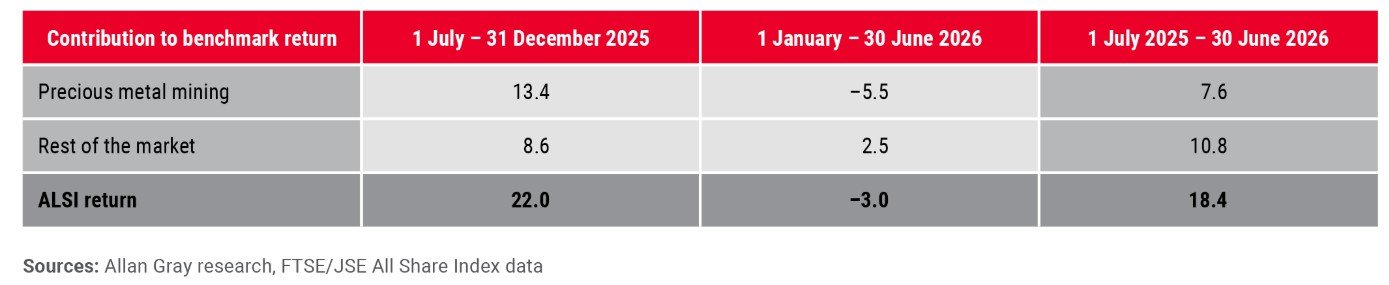
Precious metal shares drove much of the strong performance in many balanced funds. In the second half of 2025, precious metal miners contributed 13.4% of the ALSI’s 22% return.
Many balanced funds delivered returns of more than 15% in 2025. This year, several are sitting closer to 3.5% year to date. In the first half of 2026, precious metal miners detracted 5.5%, while the ALSI fell 3%.
That does not mean gold should be avoided. For a long-term objective, it can have a useful place in a diversified portfolio, although I would generally not recommend allocating more than approximately 7.5% to 10% of a portfolio to it.
The same principle applies to silver, Bitcoin, Ethereum and other investments that attract attention after a strong run.
The more useful question is what drove the return, what could reverse it, and how much of the portfolio depends on the same outcome continuing.
Historical returns tell you what happened. They do not tell you why it happened, what could bring it to an end, or whether it will happen again.
The table below shows why historical returns need context.
Food for Thought
-
Warren Buffett made approximately 95% of his wealth after 60. Compounding is unimpressive, until it is astonishing
-
The satisfaction may be brief. The years spent replacing the money are not
-
We call saving a sacrifice. Debt makes the same sacrifice on our behalf, only later and at interest
-
We borrow at double-digit interest, then agonise over losing one percentage point of return
-
We wait for certainty. By the time it arrives, the opportunity has usually sent a larger invoice
-
We say time is priceless, then trade years of it for things whose appeal lasts weeks
Quote for the Month
“Knowing what you don’t know is more useful than being brilliant.”
Charlie Munger (Warren Buffett’s long-time business partner and, one might say, a professional enemy of nonsense)
Visual For the Month
Market leadership has never been permanent. The largest companies of one decade are often replaced by the next, and several former leaders delivered poor returns in the years that followed.
This is why diversification matters. It is difficult to know which businesses will dominate the next decade, or how much of their future success is already reflected in today’s price.
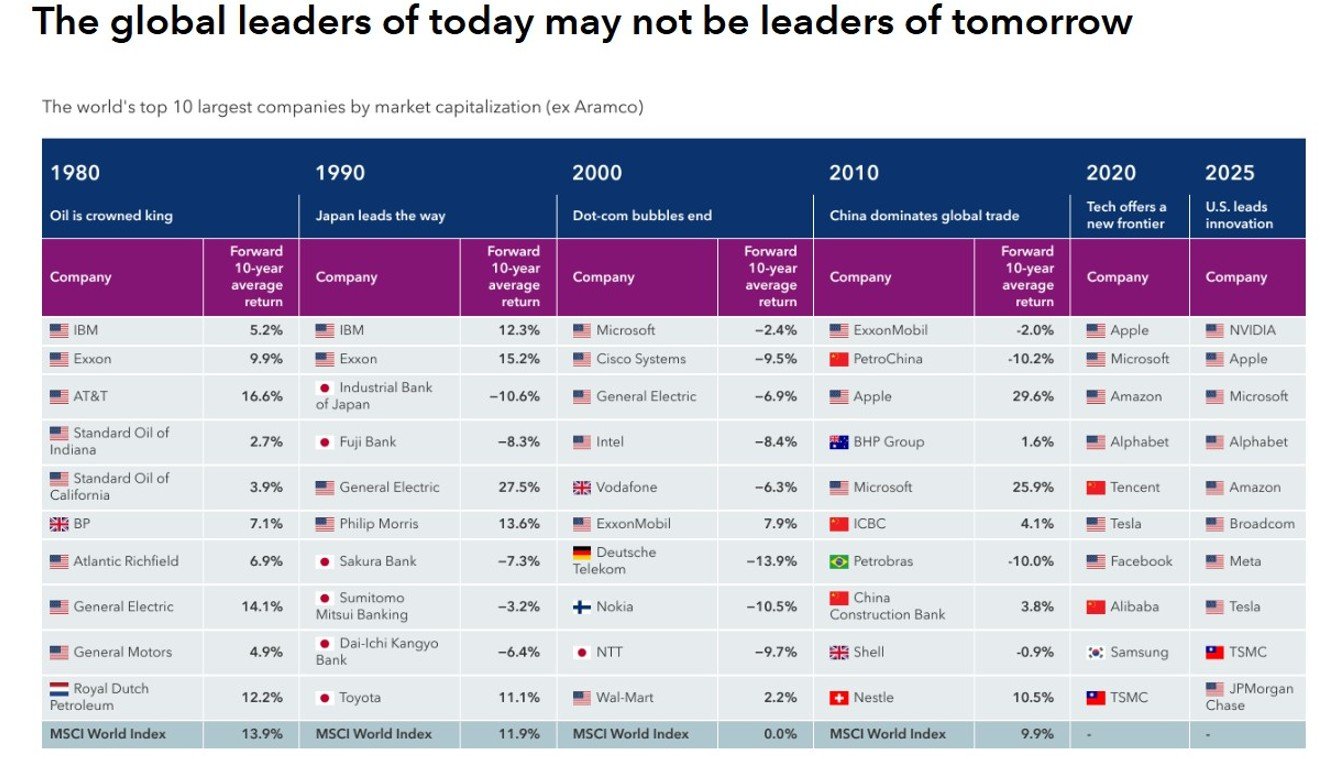
Source: Capital Group, MSCI and RIMES. Data as at 31 December 2025.
Notes: Each column shows the world’s 10 largest listed companies by market capitalisation at the stated observation date, excluding Saudi Aramco. The forward 10-year average return is the annualised total return from that observation date to the start of the following decade. The 2000 observation date is 28 February 2000, chosen as the closest month-end to the peak of the technology bubble.
Perspective for the Long Run
Who Owns Your Future?
Most people spend years trying to accumulate more, but relatively few stop to consider what enough would actually look like.
Enough is not simply a number on a statement. It is the point at which your money can support the life you want, provide a margin for uncertainty, and give you greater control over how your time is spent.
Every financial decision has a claim on your future.
Money spent on material satisfaction or short-lived utility represents a piece of your future that someone else owns. It is time you will still need to spend working for an employer or shareholders, rather than having the financial independence to decide how your time is used.
When that spending is funded by debt, a creditor also has a claim on your future income, often long after the satisfaction of the purchase has disappeared.
Every rand or dollar you keep represents a piece of your future that you own. It may eventually give you the freedom to work less, change direction, help someone you care about, retire with confidence, or simply make decisions without financial pressure.
This does not mean money should never be enjoyed. A good life is not built by postponing everything until some distant future. The point is to spend deliberately, knowing the difference between what adds meaning to your life and what quietly creates another obligation.
Without a clear idea of enough, wealth can become a moving target. The purpose of building wealth is not simply to own more. It is to gradually own more of your future.
I hope this month’s mailer gave you something valuable to think about. Looking forward to catching up again at the end of August.
Until next month, take care and as always, know that I’m here if needed.

Reference: Morningstar, Coronation, Forbes, NinetyOne, Blackrock, Bloomberg, Capital Group, Reuters, Equilibrium.
Copyright (C) 2026 Stocks+Wealth Financial Planning. All rights reserved.
The Inside Track is a publication of Stocks+Wealth Financial Planning
You are receiving this email because you are an existing client or agreed to receive information from Robert Taylor.
Our mailing address is:
Stocks+Wealth Financial Planning, 16 Virginia Ave, Vredehoek, Cape Town,Western Cape, 8001, South Africa
Email: robtaylor@stocksandwealth.co.za
The information contained in this message is intended only for the recipient and may be a confidential client communication or may otherwise be privileged and confidential and protected from disclosure. If the reader of this message is not the intended recipient, or an employee or agent responsible for delivering this message to the intended recipient, please be aware that any dissemination or copying of this communication is strictly prohibited. If you have received this communication in error, please immediately notify us by replying to the message and deleting it from your computer.
Please also be aware that the contents of this email include the opinions of the sender Robert Taylor and are not to be construed as advice or acted or before consulting with Robert Taylor or any other licensed Financial Services Provider where professional process and the FAIS act and General Code of Conduct are applied.