

29 May 2026
Welcome to the Eighteenth Edition of The Inside Track.
Here we are already at the end of May. The Cape Town storms arrived, the Premier League wrapped up, Liverpool supporters are licking their wounds, and before long the world’s attention will once again turn to World Cup football.
South Africa open against Mexico on 11 June. Whatever happens, for a few hours the country will once again pause, unite behind the same colours, and believe. For a few weeks at least, conversations around dinner tables, offices, WhatsApp groups, and braais will shift away from politics, markets, and society’s latest Malemas, or should I say dilemmas.
Interesting fact: The FIFA World Cup trophy is estimated to be worth more than 3,000% more today than when it was first awarded, largely due to the increase in the price of gold.
Globally, the last month has once again been highly dynamic, with markets, technology, energy prices and inflation remaining firmly in focus, although sentiment improved late on 28 May following reports that the United States and Iran had reached a tentative ceasefire extension agreement, pending approval.
So, with that in mind, let’s get into this month’s Inside Track.

Market Indicators
Returns % (to 24 May 2026)
| 1 Month | YTD | 1 Year | |
|---|---|---|---|
| SA Equity (ALSI) | -4.0 | -0.6 | 25.8 |
| SA Bonds (ALBI) | -0.5 | 0,6 | 22,3 |
| SA Property (ALPI) | -1.8 | 0.5 | 28.9 |
| SA Cash (Avg. SA Money Market Fund) | 0.5 | 2.6 | 7.1 |
| Global Markets (MSCI ACWI in ZAR) | 3.9 | 9.4 | 18.3 |
| Global Markets (MSCI ACWI in USD) | 4.0 | 10.3 | 29.4 |
| USD/ZAR - R16.53/USD at 25 May 2026, negative number indicates appreciation of the rand | -0.22 | -0.4 | -7.7 |
Market Pulse: Market Moves and Your Portfolio
Global markets remained relatively resilient, particularly in US dollar terms, supported by stronger-than-expected corporate earnings in parts of the US market.
The Rand held relatively steady against the US dollar during the month, although currency markets continue to react sharply to changing interest rate expectations.
Locally, the pullback in broader commodity prices has weighed heavily on the JSE resource sector, which is now down 21.45% since the start of the conflict. This has in turn placed pressure on the broader JSE, property and the bond market.
Inflation and interest rates are back in the driver’s seat. For those already invested, they will influence portfolio values. For those with cash available, they may create opportunities.
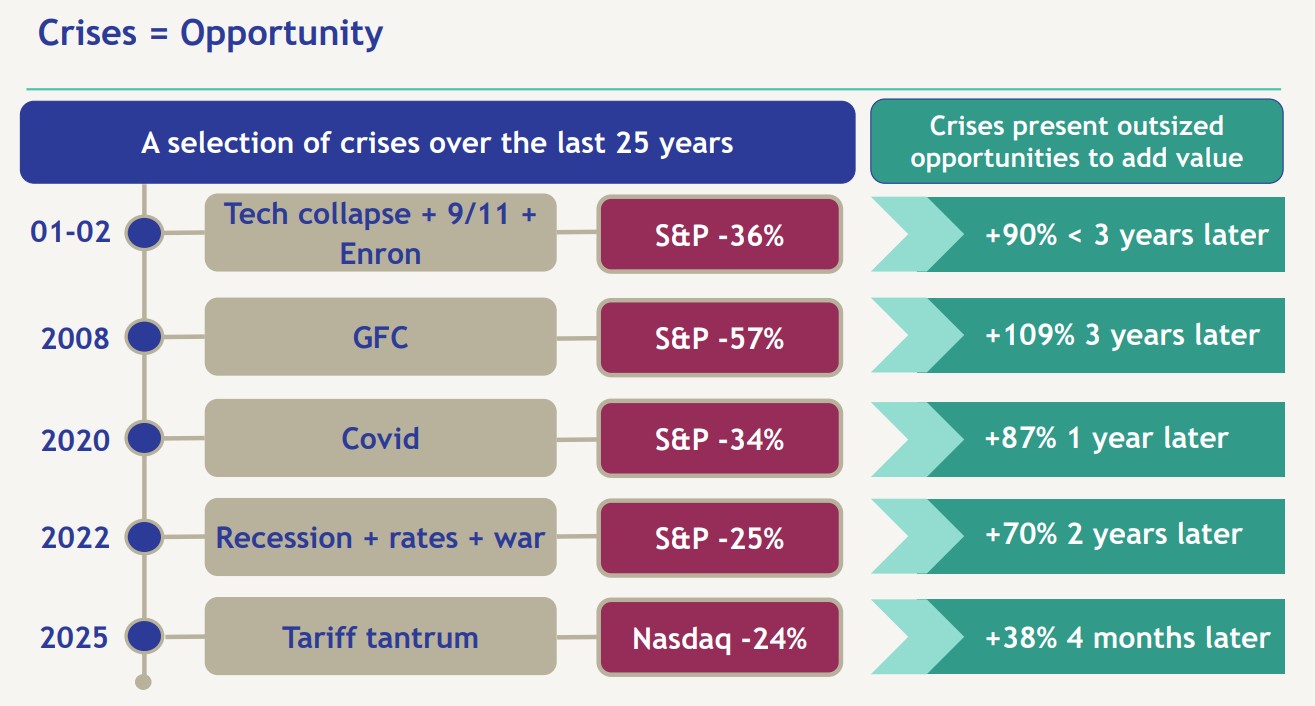
Key Global Market Insights
-
Global equities reached fresh all-time highs during May, with the MSCI All Country World Index climbing to a new record
-
Brent crude oil recorded its largest monthly decline since March 2020 as fears of a major energy supply disruption began to ease
-
The S&P 500 is on track for a ninth consecutive week of gains, a streak achieved only four times since 1985
-
Kevin Warsh was confirmed as Federal Reserve Chair in a 54–45 Senate vote, the most partisan Fed confirmation on record
-
Australia launched the first vessel in a planned strategic fleet designed to strengthen national supply chains during future crises
-
India tightened gold import restrictions, a move that could reduce demand from one of the world’s largest gold markets
-
Anthropic raised funding at a valuation of $965 billion, overtaking OpenAI as the world’s most highly valued AI company
-
Despite President Trump promoting the United States as the “crypto capital of the world” and renewing support for the CLARITY Act, Bitcoin fell below $73,000
Key South African Financial Insights
-
Interest rates increased by 0.25%, with markets currently expecting up to three additional increases over the next 12 months
-
Inflation accelerated to 4.0% in April, its highest level since August 2024, driven largely by housing, utilities and transport costs
-
Inland petrol prices climbed to R23.25 per litre following one of the largest fuel price increases of the past 50 years
-
Moody’s revised South Africa’s outlook to positive for the first time since 2007, although the country remains below investment grade
-
South Africa is now exporting almost twice as much electricity as it imports, a notable shift from the energy challenges of recent years
-
South Africa’s AI adoption rate rose to 23.1% during the first quarter of 2026, placing the country 46th out of 147 economies surveyed
-
South Africa’s mining sector continues to increase investment in privately contracted renewable energy as global carbon regulations reshape international competitiveness
Blind Spots That Can Undermine Financial Peace of Mind
Never confuse what should happen with what will happen.
Careers should progress. Businesses should grow. Health should remain stable. Markets should recover quickly.
Life, however, does not always follow the script.
Many people who ultimately prosper financially are not necessarily more intelligent, more talented, or even higher earners. They simply realise earlier that earned income is temporary. It depends on time, health, energy, skills, and circumstances, all of which eventually change.
Rather than allowing every increase in income to become a larger lifestyle, they use part of it to acquire productive assets capable of creating future wealth.
Others unintentionally allow income to fund lifestyles before building the assets needed to support them. Bigger homes, newer cars, holidays, and possessions are not the problem, they are often rewards for hard work.
The problem begins when today’s income becomes responsible for permanently funding tomorrow’s lifestyle. Sooner or later circumstances change, and assets, or the lack of them, begin determining the outcome
Food for Thought
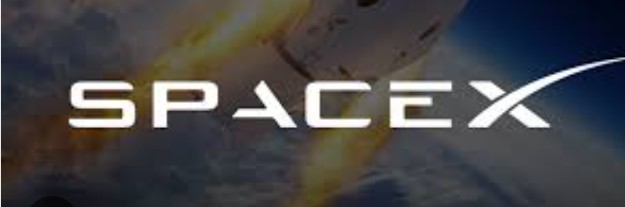
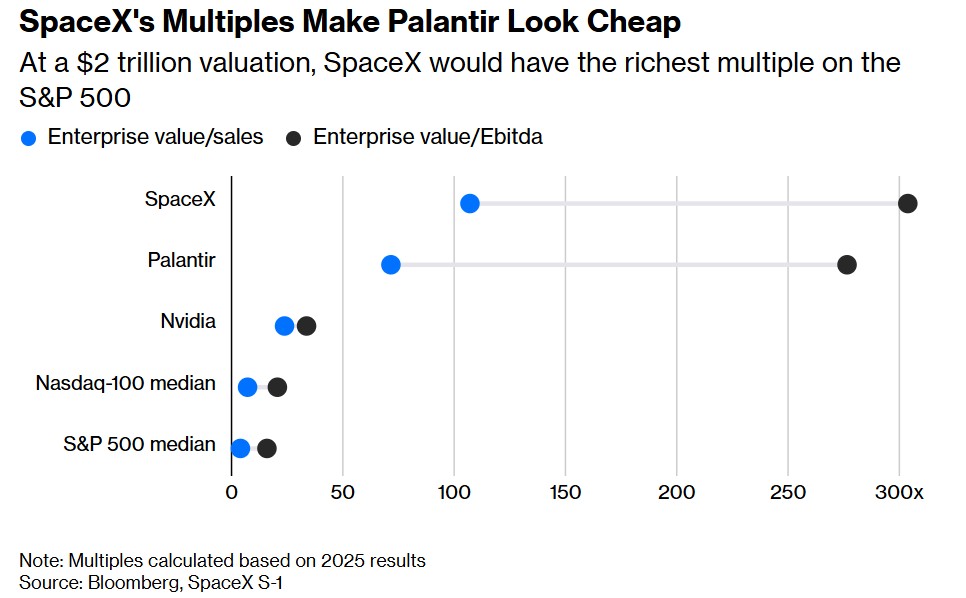
Few companies in modern history have generated as much excitement as SpaceX potentially heading toward an IPO. At the valuations being discussed globally, the company could briefly become one of the most valuable businesses on earth.
What makes SpaceX particularly fascinating is that it is no longer just a rocket company. Since 2023, it has reportedly launched more than 80% of the world’s satellites into orbit by weight, while Starlink now operates roughly 9,600 satellites globally.
Beyond satellite internet, the company is already speaking about future possibilities such as space tourism, ultra-fast global travel, space manufacturing, and even orbital data centres in the years ahead.
What you may not know is that Elon Musk is reportedly considering a possible future merger between Tesla and SpaceX, with parts of Wall Street already speculating that the two companies could eventually be linked more closely following SpaceX’s anticipated IPO.
For those wondering if there are ways to gain exposure to companies such as SpaceX, Anthropic, and OpenAI before they become more broadly accessible to investors, there are structures available that provide access to these opportunities.
If this possibly interests you, feel free to email me: robtaylor@stocksandwealth.co.za
Quote for the Month
“There are two kinds of forecasters: those who do not know, and those who do not know they do not know.”
– John Kenneth Galbraith
A reminder that successful investing has rarely been about predicting the future perfectly, but rather preparing for uncertainty.
Visual For the Month
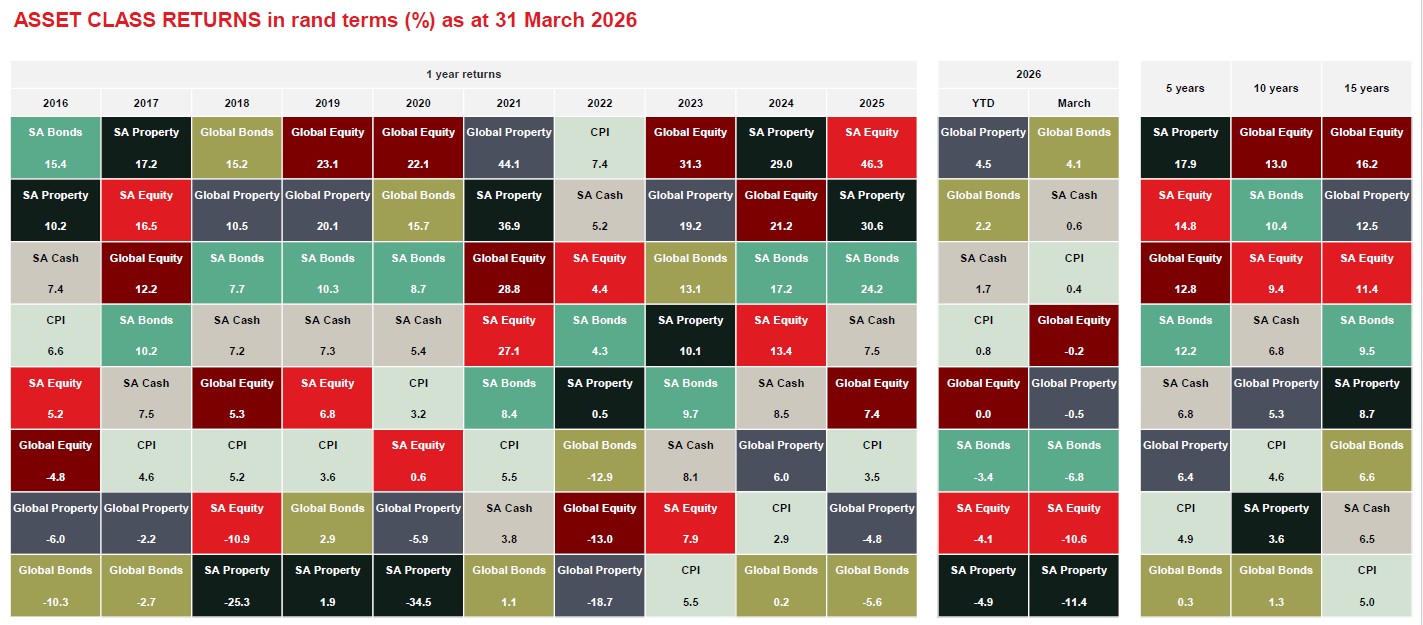
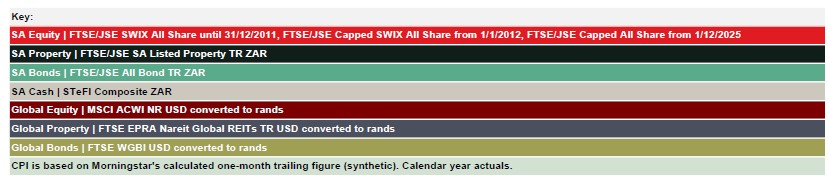
This image is a powerful reminder of how quickly markets can humble certainty. The best-performing asset class one year can easily become one of the weakest the next, often just when investors become most confident.
And yet, despite wars, recessions, inflation shocks, political crises, pandemics, and countless predictions of collapse over the last decade, global equity has still quietly compounded into one of the strongest long-term performers overall.
Ironically, many individuals still choose the emotional comfort of money market funds and try to time the market while inflation and tax quietly erode purchasing power in the background year after year.
Perspective for the Long Run
Many people assume financial outcomes are shaped by major decisions.
Buying the right property, selecting the right investment, selling a business, receiving an inheritance.
Yet after years of working with people across different circumstances, one observation stands out: significant financial outcomes are often shaped by seemingly insignificant decisions repeated over long periods.
A simple example.
An unexpected amount of money becomes available. It could be R1,000, R5,000, or any amount relative to someone’s circumstances and goals.
For a brief moment there is usually a thought:
“I should invest this, reduce debt, or put it aside.”
Then another thought often follows:
“What difference is this really going to make?” The reasoning feels sensible.
Behavioural economists refer to this as hyperbolic discounting, our tendency to place greater value on immediate rewards than rewards that may only arrive years into the future.
The purchase feels real. The enjoyment is immediate. Investing toward a future outcome often feels distant and abstract. The interesting part is that the decision itself is rarely about the amount.
It is often about the behaviour being reinforced.
“This amount is too small to matter.”
The challenge is that the threshold tends to move.
If R1,000 feels too small, perhaps R5,000 does too. Then the next bonus. Then the next salary increase. Then the next year.
The encouraging part is that behaviour works both ways.
Just as small decisions repeated over time can quietly move us away from where we want to be, small decisions repeated consistently can also move us closer.
The frustrating thing about progress is that it often feels invisible in the beginning.
Then one day the investments, the habits, and the discipline that once felt insignificant become the very things that changed the outcome.
I hope this month’s mailer gave you something valuable to think about. Looking forward to catching up again at the end of June.
Until next month, take care and as always, know that I’m here if needed.

Reference: Morningstar, Coronation, Forbes, NinetyOne, Blackrock, Bloomberg, Capital Group, Reuters, Equilibrium.
Copyright (C) 2026 Stocks+Wealth Financial Planning. All rights reserved.
You are receiving this email because you are an existing client or agreed to receive information from Robert Taylor.
Our mailing address is:
Stocks+Wealth Financial Planning, 16 Virginia Ave, Vredehoek, Cape Town,Western Cape, 8001, South Africa
Email: robtaylor@stocksandwealth.co.za
The information contained in this message is intended only for the recipient and may be a confidential client communication or may otherwise be privileged and confidential and protected from disclosure. If the reader of this message is not the intended recipient, or an employee or agent responsible for delivering this message to the intended recipient, please be aware that any dissemination or copying of this communication is strictly prohibited. If you have received this communication in error, please immediately notify us by replying to the message and deleting it from your computer.
Please also be aware that the contents of this email include the opinions of the sender Robert Taylor and are not to be construed as advice or acted or before consulting with Robert Taylor or any other licensed Financial Services Provider where professional process and the FAIS act and General Code of Conduct are applied.