

30 September 2026
Welcome to the Twenty-First Edition of The Inside Track.
Hello. Spring is properly under way, Christmas is somehow only 12 weeks away, and I hope the holiday planning is beginning to take shape, with a good break and some proper time with family and friends to look forward to.
This year seems to have flown by, and it has also been one of the more dynamic years I can remember in markets and the broader economic landscape, with interest rates, geopolitics, technology, disruption and global policy decisions all keeping us on our toes.
With the US midterms now just around the corner, perhaps we may even get a brief pause in the political theatre. One can hope.
This month we look beyond the headlines at a few of the things that are easily overlooked: financial blind spots, why time seems to move faster as we get older, whether a tax incentive necessarily produces the best net investment outcome, and why places such as Guernsey and the Isle of Man are better understood as tax-neutral financial centres rather than tax havens.
A fairly mixed bag, perhaps, but all connected by the same idea: looking a little deeper before drawing the obvious conclusion.
So, with that in mind, let’s get into this month’s Inside Track.
Market Indicators
Returns % (to 25th September 2026)
| 1 Month | YTD | 1 Year | |
|---|---|---|---|
| SA Equity (ALSI) | -4.3 | -1.2 | 8.19 |
| SA Bonds (ALBI) | 0.8 | 3.3 | 12.6 |
| SA Property (ALPI) | 0.7 | 3.2 | 19.6 |
| SA Cash (Avg. SA Money Market Fund) | 0.6 | 5.0 | 7.6 |
| Global Markets (MSCI ACWI in ZAR) | 2.3 | 12.6 | 12.0 |
| Global Markets (MSCI ACWI in USD) | 0.0 | 14.3 | 19.5 |
| USD/ZAR - R16.65/USD at 28 Sept 2026, negative number indicates appreciation of the rand | 2.3 | -1.4 | -6.5 |
Market Pulse, What the numbers tell us.
Interest rates are rising again
Here at home, the Reserve Bank raised the repo rate from 7.00% to 7.25% in September, taking prime to 10.75%. Inflation is currently 4.4%, but the risks are still tilted upwards, mainly because of higher fuel prices. Longer-term inflation expectations are also sitting at around 4%, above the SARB’s new 3% target.
The Bank is also watching higher global interest rates and the impact of the conflicts in the Middle East and Ukraine. The concern is that higher fuel costs start feeding into the price of everything else, which is exactly what they are trying to prevent.
For now, the SARB expects rates to remain broadly stable for the rest of the year, with cuts only coming later as inflation settles. It does not expect inflation to return to 3% until the end of 2027, while South Africa’s growth forecast for this year has been revised down to just 1.2%.
For investors, the practical effect is fairly simple: cash continues to earn a decent return, but mortgages, property finance and business borrowing remain expensive.
Bonds are being repriced
In the U.S., stubborn inflation, higher energy prices and expectations of higher interest rates have pushed bond yields up and existing bond prices down.
There is also a large amount of new debt being issued, which means governments and companies have to offer investors attractive yields to absorb it. U.S. government debt is now above $40 trillion, while technology companies are borrowing heavily to fund AI data centres, chips and infrastructure.
That has been uncomfortable for existing bondholders, but the flip side is that bonds are starting to offer much better income again.
Equities are more mixed
Global shares have held up surprisingly well, supported by company earnings and continued investment in AI. Walt Disney Company gained 11.1% after reporting stronger-than-expected third-quarter earnings, helped by robust theme park spending and improving streaming profitability. Interactive Brokers rose 9.9%, supported by continued growth in client accounts, assets and margin balances.
However, higher interest rates are making investors less willing to pay very high valuations for shares.
In South Africa, weaker commodity prices have been a drag on the JSE this year, with mining shares bearing much of the pressure. At the same time, several clothing and discretionary retailers have struggled as consumers spend more carefully, margins come under pressure and brand competition intensifies.
What does this mean for investors?
Stay diversified and do not chase last year’s winners. Cash, bonds, property, local equity and global equity all play different roles through the cycle.
Where a portfolio is providing retirement income, strong markets can encourage spending to creep higher. Recency bias makes unusually good returns feel more normal than they are. Do not let a strong run in markets change a well-considered spending plan. Stick to your plan.
For long-term growth, owning good, income-producing businesses at the right price continues to reward patience over time.
Key Global Financial Insights
-
Global interest rates turned more hawkish. The Fed raised rates by 25bp to 4.00%, the ECB also hiked, the Bank of Japan raised rates to 1.25%, while the Bank of England held in a 6–3 vote
-
Bond markets came under pressure, with the US 10-year Treasury yield briefly touching 5% for the first time since 2007
-
Trump and Xi met in Washington, extending the trade truce and agreeing to examine AI risks together, while tariffs and Taiwan remain unresolved
-
Oil remained volatile, with Tehran proposing a seven-day plan to reopen the Strait of Hormuz and restart broader negotiations. Donald Trump rejected the ceasefire offer
-
US retail sales rose 1.2% in August, the strongest monthly increase in five months
-
China’s industrial profits rose just 4.2% in August, the weakest pace this year, as consumer demand remained soft and energy costs increased
-
Gold is down about 20% from its January record, trading near $4,300 an ounce, even as central banks bought a record 289 tonnes in the second quarter
-
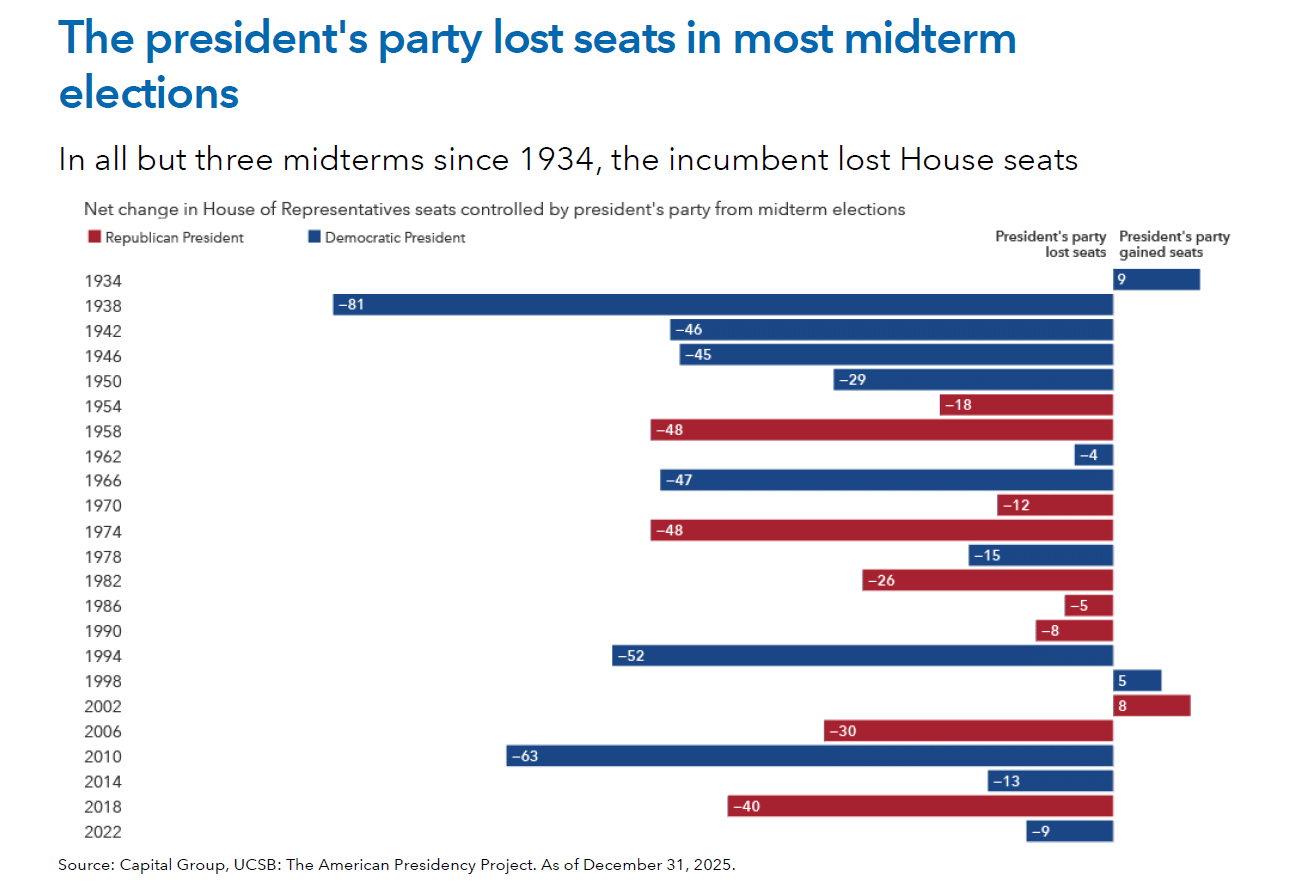
Midterm elections are held halfway through a US presidential term, and history has generally been unkind to the president’s party
Across the past 23 midterms, the president’s party has lost an average of 27 seats in the House of Representatives and three in the Senate. Only twice has it gained seats in both chambers.
There are a couple of reasons for this pattern. Supporters of the opposition party are often more motivated to turn out, while presidential approval ratings also tend to soften during the first two years in office.
Markets are well aware of this history and generally price in some loss of seats for the president’s party. The bigger uncertainty is how large that shift may be, and what it could mean for policy once the votes are counted.
Key South African Financial Insights
- The SARB raised the repo rate 25bp to 7.25%, taking prime to 10.75%
- Headline inflation rose to 4.4% in August, from 4.3% in July
- Demand for SA government bonds remained strong, with Tuesday’s auction nearly six times oversubscribed
- Gold Fields’ A$39 billion takeover approach was rejected by Australia’s largest gold producer
- US-South Africa tensions escalated, with Washington imposing visa restrictions on certain South Africans over policies it says involve racial discrimination, land seizures or incitement to violence
Blind Spots That Can Undermine Financial Peace of Mind
Put R1 million Blind Spot
One of the more significant financial blind spots I come across is the assumption that, because we have medical aid, the financial consequences of a serious illness are largely covered.
That is not necessarily the case.
Take cancer treatment. Immunotherapies such as Keytruda help the body’s own immune system recognise and attack certain cancer cells. For some patients they can form an important part of treatment, but they can also be extremely expensive.
A course of immunotherapy can cost R1 million to R1.5 million or more, and medical aid does not necessarily mean that cost disappears. Depending on the scheme, plan and treatment criteria, a substantial shortfall may remain. Some may not cover it at all.
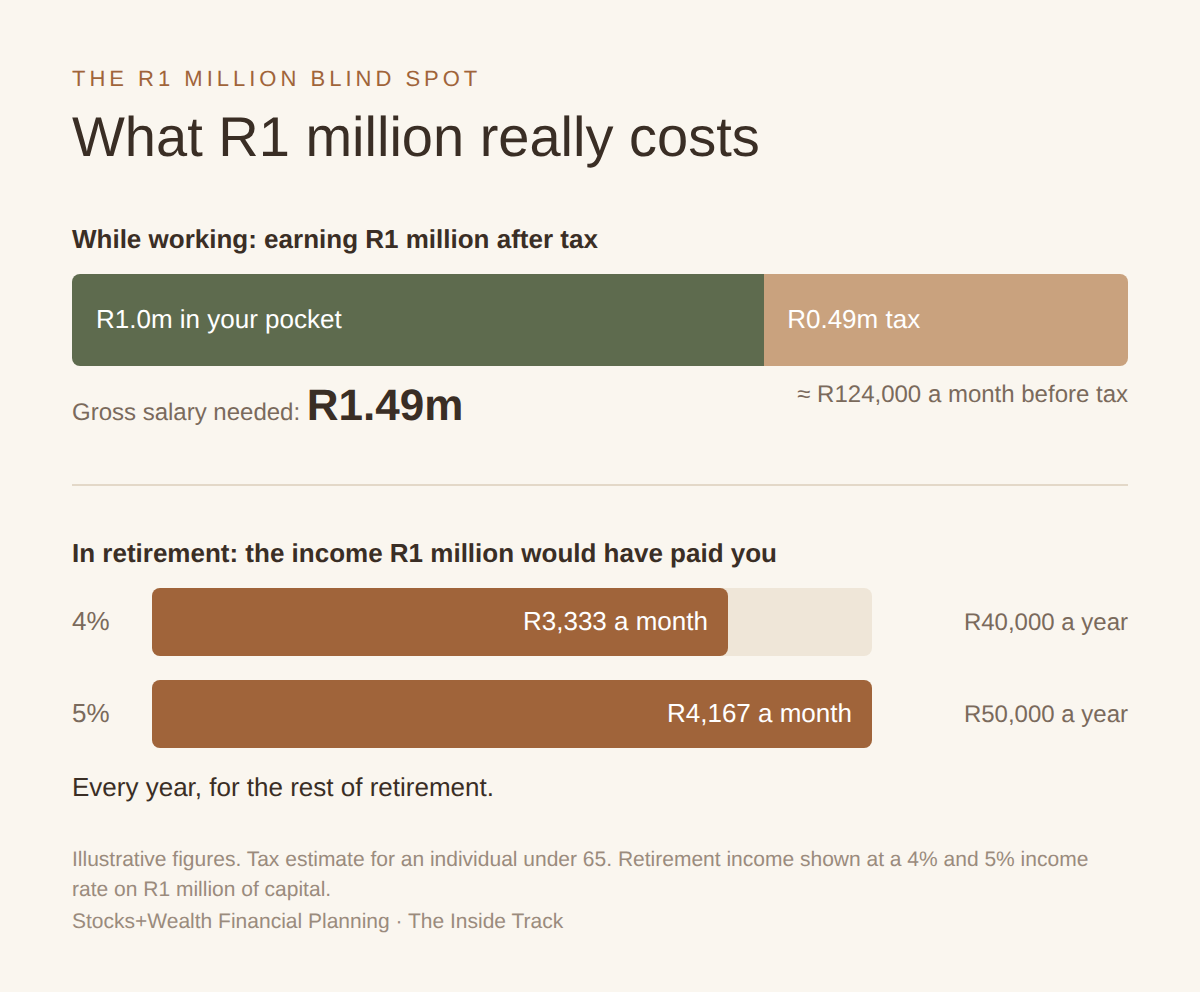
Put R1 million into perspective.
For someone under 65 to have R1 million available after tax from employment income, they would need to earn roughly R1.49 million before tax, around R124,000 per month gross.
In retirement, the impact is different but equally important.
If R1 million has to be taken from investment capital, at a 4% income rate that capital represents roughly R40,000 a year, or R3,333 per month, of retirement income. At 5%, it is R50,000 a year, or about R4,167 per month
Then there is liquidity.
Many people approaching retirement may have considerable wealth, but much of it sits in retirement funds, property or other structures that are not immediately accessible. Even where the money is available, removing R1 million can materially change a retirement plan that took years to build.
This is why chronic illness/ dread disease cover should form part of proper financial planning. As a broad rule of thumb, R1 million to R1.5 million of meaningful cover is a sensible starting level to consider, where affordable.
Just as importantly, it should not simply be an over-the-counter insurance product bought from a heavily marketed insurance company for the sake of having cover.
What may feel like a quick and painless exercise when taking out a policy can look very different when it comes time to claim. The definitions, severity levels, exclusions and percentage of the benefit actually payable are what matter then.
The blind spot is not the illness. It is believing the financial risk has already been dealt with.
Food for Thought
Why does time seem to move faster as we get older?
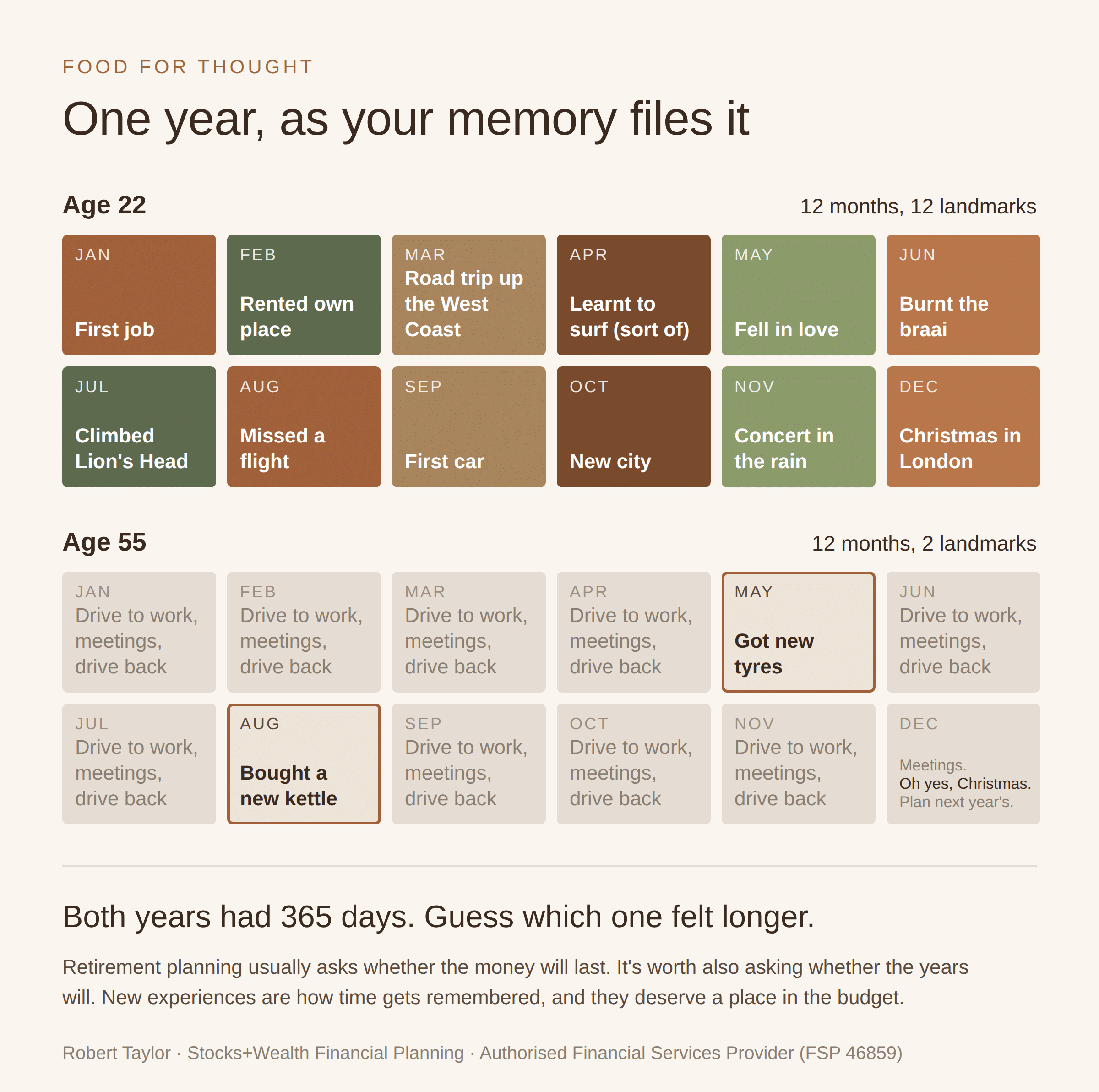
When we are young, life is filled with firsts: a first job, a first home, new friendships and unfamiliar places. Each creates a distinctive memory, almost like a timestamp, helping the brain divide life into recognisable chapters.
As we get older, routines take over. Similar days, familiar places and recurring tasks begin to overlap. Your 47th Monday morning meeting is unlikely to become a landmark memory.
Researchers call the dividing points between experiences event boundaries. New places, activities and experiences create more of them, making periods of our lives feel fuller when we look back.
So, if you are tired of feeling that time is flying by, one answer may be to keep life fresh. Learn something new, visit somewhere unfamiliar and, importantly, break the routine from time to time.
When was the last time you did something for the first time?
Quote for the Month
“Grant me the serenity to accept the things I cannot change,
the courage to change the things I can,
and the wisdom to know the difference.”
The Serenity Prayer
Visual For the Month
Before you put everything into a retirement annuity
A prospective client once asked me why she shouldn’t put all her savings into retirement annuities. It’s a fair question. Contributions can qualify for a tax deduction. Growth inside the fund is tax-free, and the money falls outside your estate for estate duty.
But the head start only pays off if two things hold. You must reinvest the tax refund, not spend it. And the retirement annuity, with its restrictions, must do at least as well as an unrestricted portfolio that started with less.
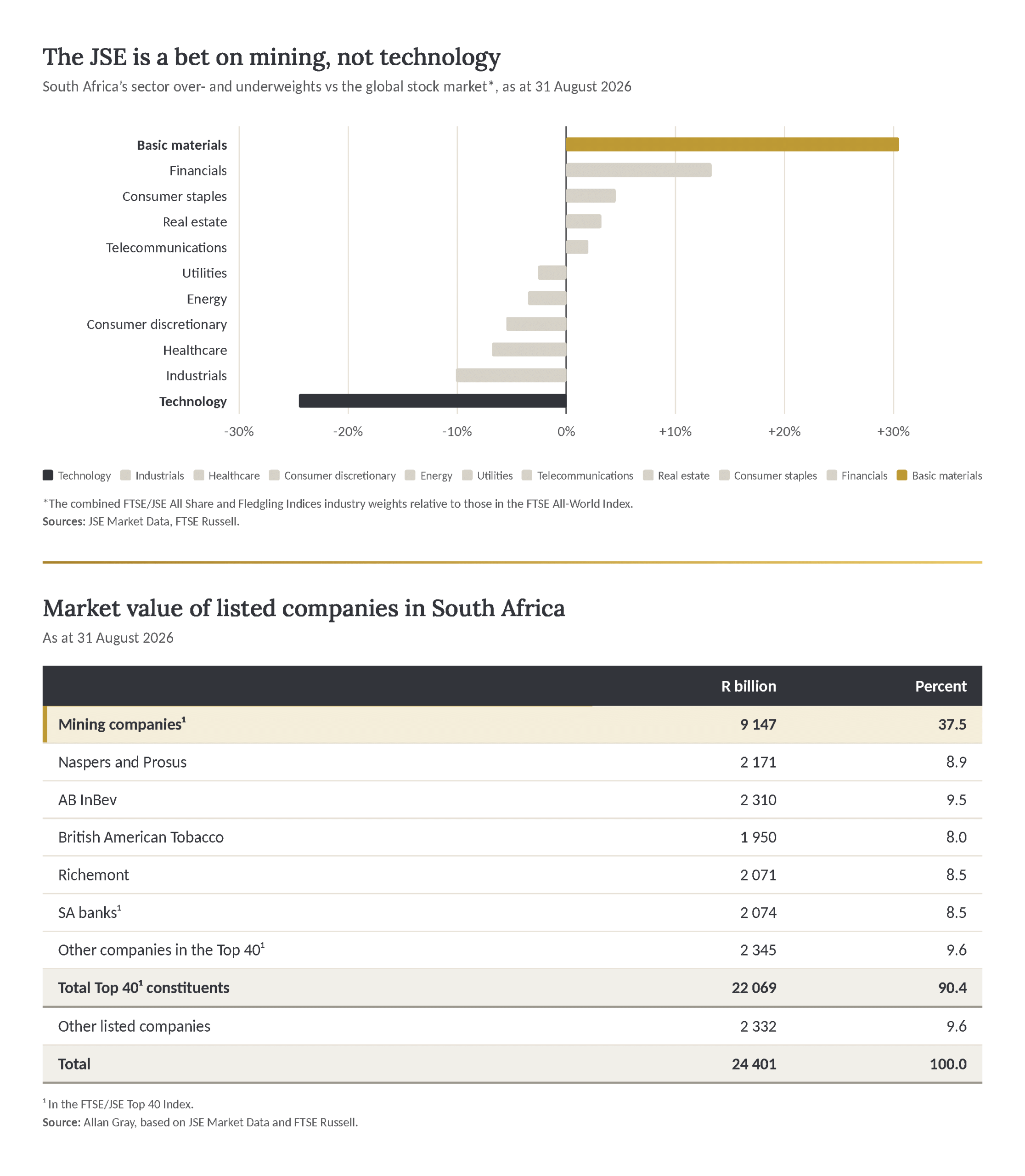
Under Regulation 28, at least 55% must stay in South Africa. South Africa makes up about 0.4% of the world’s stock market, less than half of one percent.
In August, mining and financial shares were 62.6% of the local market, against 18.9% globally. Technology was underrepresented by almost 25 percentage points.
Neither choice is right for everyone. It depends on your tax rate, your time horizon and what else you own.
And the rules can change. In 2024, the Minister of Finance called the 45% offshore allowance “a grave mistake”.
For many people, the answer is both: retirement annuities where the tax benefit counts most, and investments free to go wherever the opportunity is.
The better question isn’t how much tax you can save. It’s where each rand works hardest.
Perspective for the Long Run
Tax-Neutral Does Not Mean Tax-Free
Why would a South African investor hold money in Guernsey or the Isle of Man?
For some, the word “offshore” still brings to mind secret bank accounts, tax havens and money hidden from the taxman. That picture is increasingly outdated.
If you are a South African tax resident, SARS taxes you on your worldwide income and capital gains, subject to the usual exemptions, exclusions and tax agreements. Moving money offshore does not make that obligation disappear.
The attraction of a tax-neutral jurisdiction is more practical. It is generally designed not to add another unnecessary layer of local tax between the investment and the investor.
Guernsey and the Isle of Man are two well-known examples, alongside Jersey, Mauritius, Ireland and Luxembourg, although each has its own rules and tax system.
These are also highly regulated financial centres, which matters for the investor. Providers are subject to formal regulatory oversight, anti-money-laundering controls, client-identification requirements and international reporting standards.
In practical terms, that means greater transparency, proper record-keeping and information being shared with the relevant tax authorities where required. The attraction is not secrecy. It is holding international investments in a well-regulated jurisdiction without unnecessarily adding another layer of tax.
So the distinction is worth understanding.
The popular image of a tax haven is somewhere used to escape or conceal tax.
A tax-neutral jurisdiction is designed to avoid adding an unnecessary additional layer of tax.
For a South African investor, SARS still gets a seat at the table. It simply should not need two chairs.
I hope this month’s mailer gave you something valuable to think about. Looking forward to catching up again at the end of November.
Until next time, take care and as always, know that I’m here if needed.

Reference: Morningstar, Coronation, Forbes, NinetyOne, Blackrock, Bloomberg, Capital Group, Reuters, Equilibrium.
Copyright (C) 2026 Stocks+Wealth Financial Planning. All rights reserved.
The Inside Track is a publication of Stocks+Wealth Financial Planning
You are receiving this email because you are an existing client or agreed to receive information from Robert Taylor.
Our mailing address is:
Stocks+Wealth Financial Planning, 16 Virginia Ave, Vredehoek, Cape Town,Western Cape, 8001, South Africa
Email: robtaylor@stocksandwealth.co.za
The information contained in this message is intended only for the recipient and may be a confidential client communication or may otherwise be privileged and confidential and protected from disclosure. If the reader of this message is not the intended recipient, or an employee or agent responsible for delivering this message to the intended recipient, please be aware that any dissemination or copying of this communication is strictly prohibited. If you have received this communication in error, please immediately notify us by replying to the message and deleting it from your computer.
Please also be aware that the contents of this email include the opinions of the sender Robert Taylor and are not to be construed as advice or acted or before consulting with Robert Taylor or any other licensed Financial Services Provider where professional process and the FAIS act and General Code of Conduct are applied.